

f.l.t.r.: Prof. Dr. Klaus Albrecht Schröder, General Director Albertina, Angela Stief, Director Albertina Modern, Athi-Patra Ruga, Laureate of the 8th Art Prize Ruth Baumgarte, Alexander Baumgarte, Chairman of the Board of the Ruth Baumgarte Art Foundation
Impressions of the Award Ceremony at the Albertina Wien
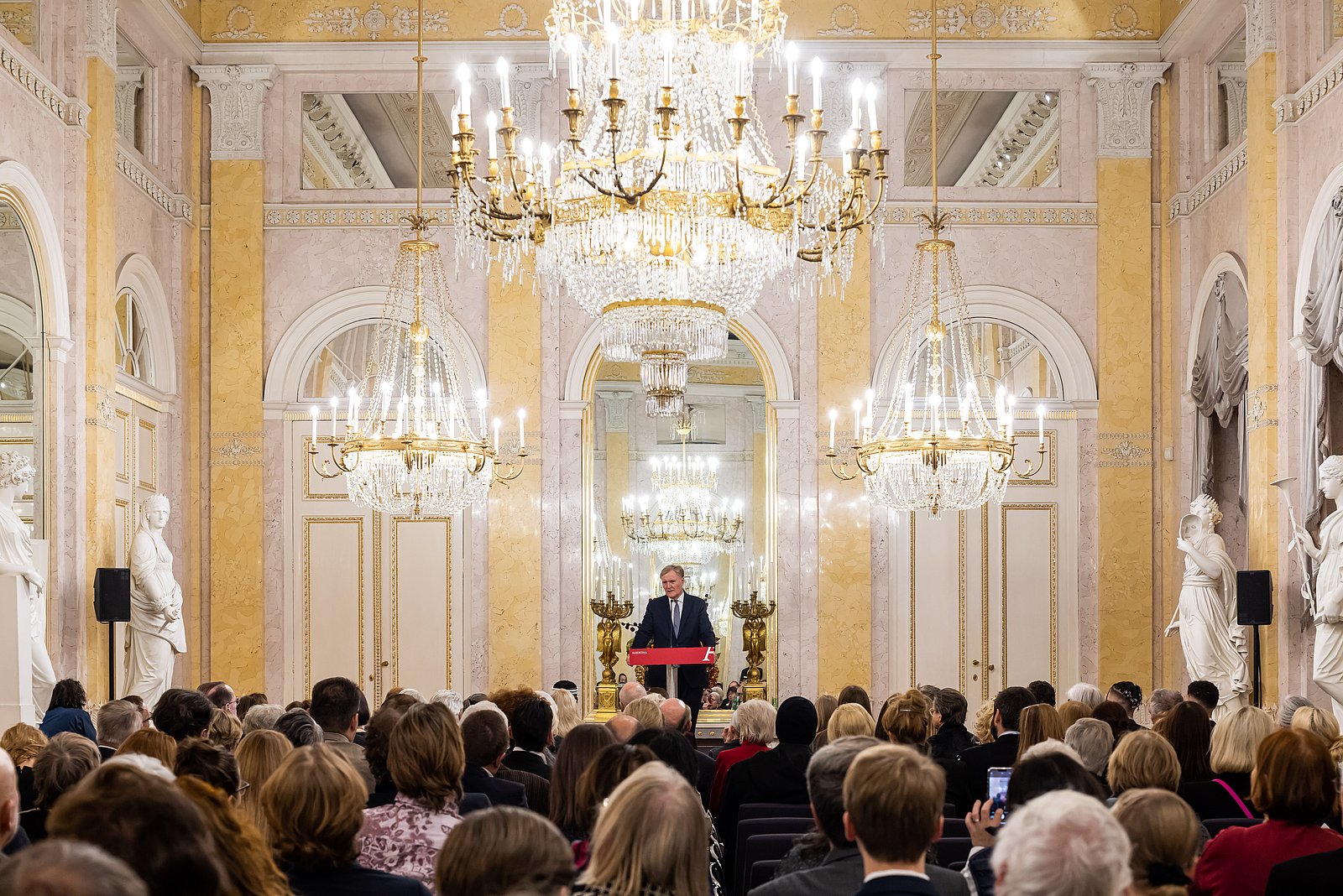
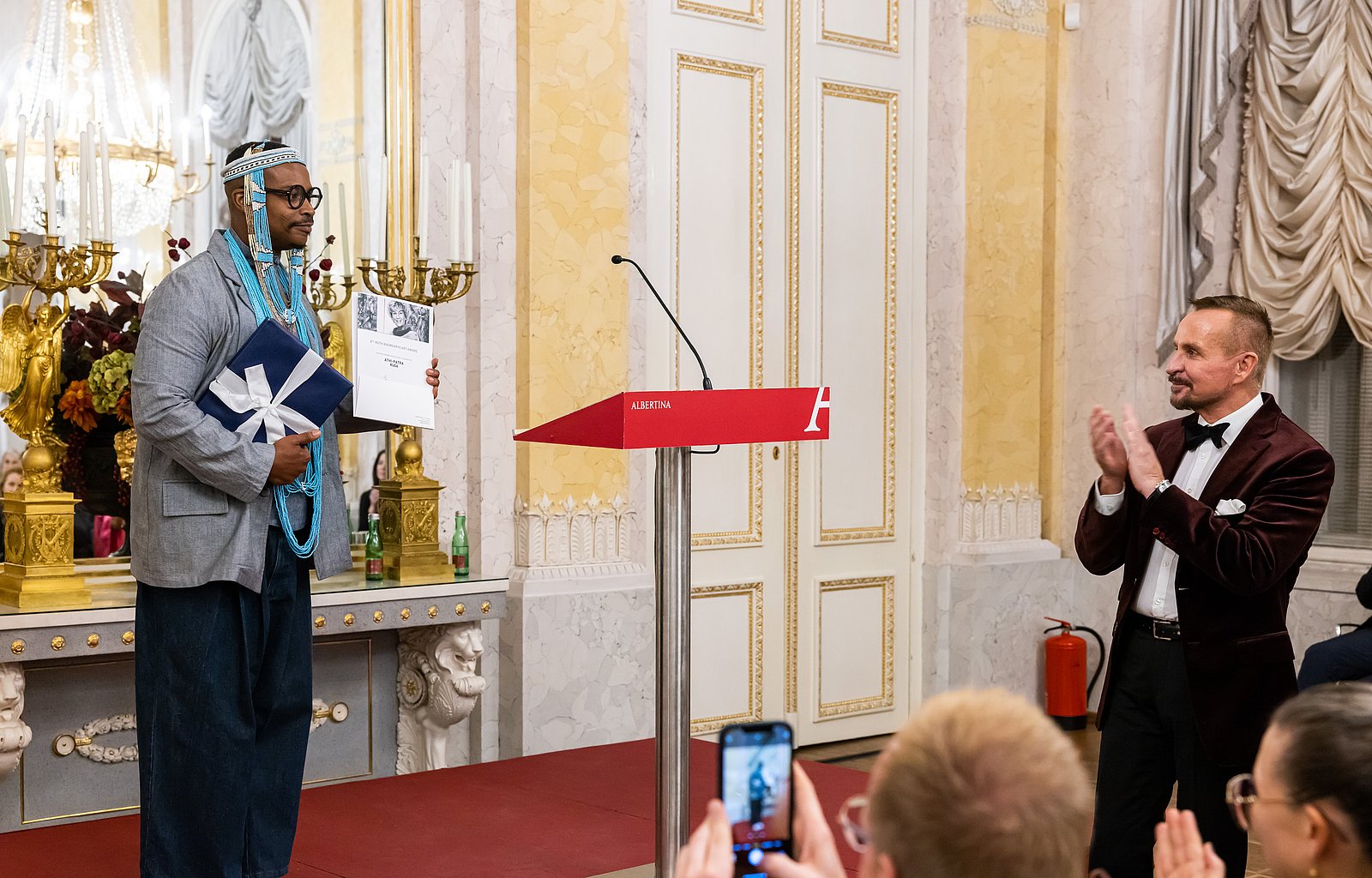
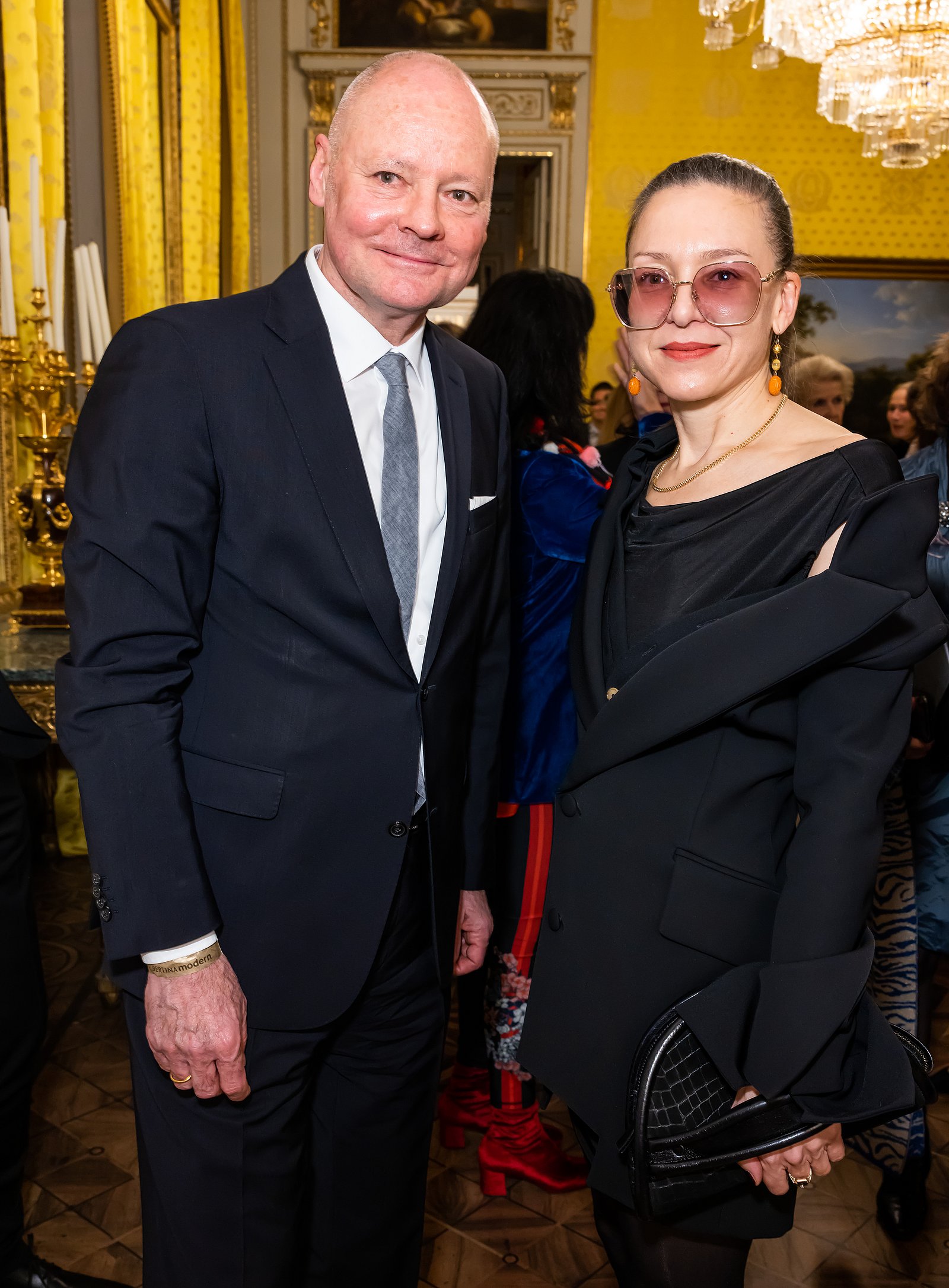


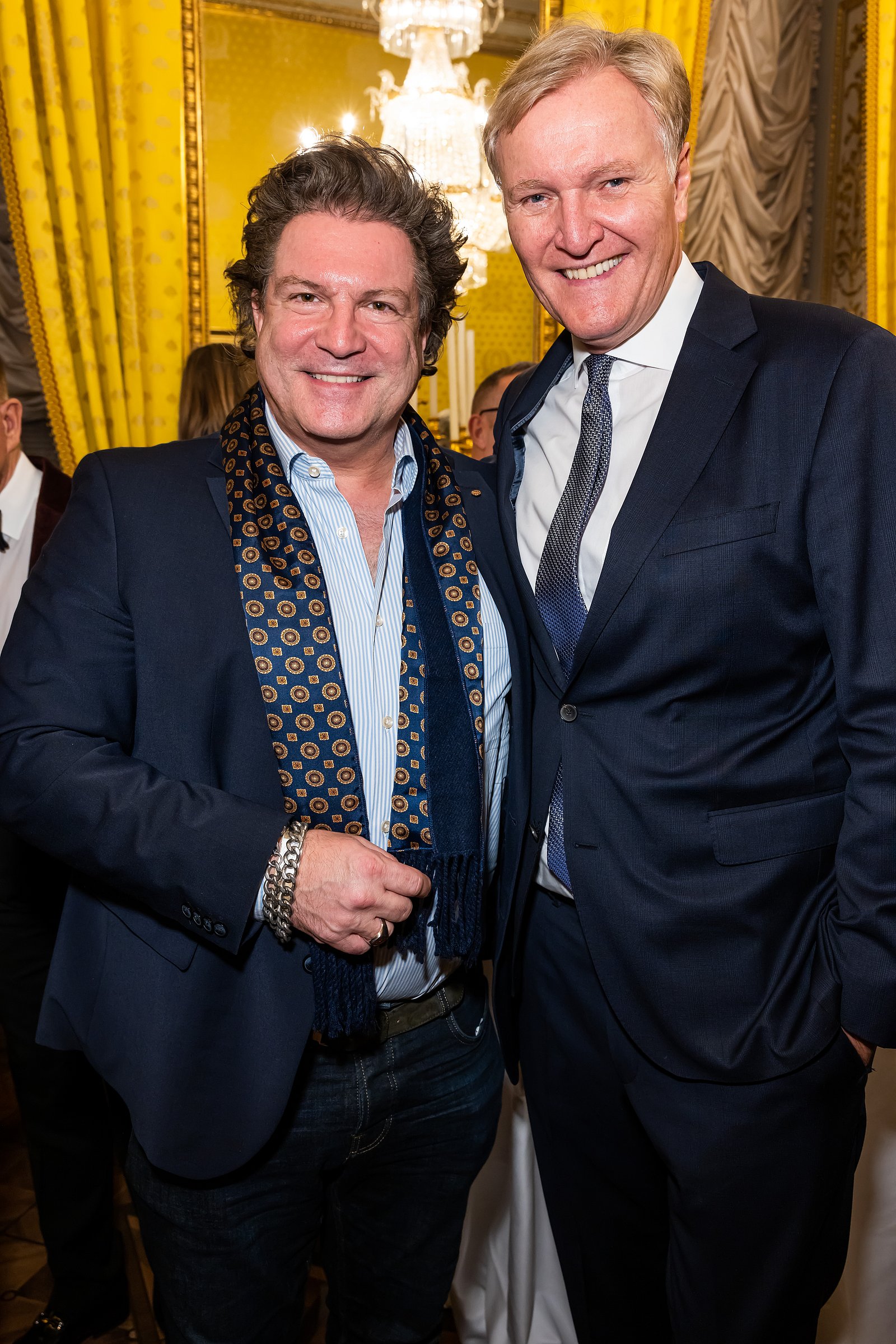

Photo: Sebastian Drüen

Athi-Patra Ruga in the studio of Irma Stern, 2021
In 2022, the Museum Advisory Board of the Ruth Baumgarte Art Foundation will award the 8th Ruth Baumgarte Art Prize to South African artist Athi-Patra Ruga (b. 1984 in Umtata, South Africa).
Athi-Patra Ruga works with performance, video, textiles and printmaking to explore notions of utopia and dystopia, materiality and memory culture. His opulent cross-stitch tapestries, sometimes enriched with objet trouvé, have particular radiance. Ruga's work relates the body to sensuality, culture, and ideology. Themes of identity, sexuality, memory, and power permeate his work.
His artistic approach to creating myths and alternative realities is an attempt to view the traumas of the last 200 years of colonial history from a place of distance, his imaginary world Azania - a term from the 1950s anti-apartheid movement "a post-apartheid, decolonial, and equal South Africa" where they exist outside of personal grief and subjective defenses.

Dr. Renée Gadsden, co-founder of the Institute for Language Arts at the University of Applied Arts, Vienna, in the catalog for the exhibition "RUTH BAUMGARTE - Africa: Visions of Light and Color" at the Albertina, Vienna
"As an artist, Ruga, in his own words, wants to question the past and make the present bearable. One of his central messages is that of hope for a fabulous, happy, better future. He looks at the world with wonder and awe, and his art makes a statement that Africa, beyond its role as a supplier of material and immaterial raw materials and resources, also has a creative significance in its own right for the world.
There are many similarities between Athi-Patra Ruga's art and that of Ruth Baumgartes. The powerful colors and the way the sitter is portrayed open a window-like view of complex emotional states. While Baumgarte traveled to large parts of Africa for her studies of women and men, Ruga is more self-sufficient and usually portrays herself, whether as a woman, a man, or even an androgynous being. Questioning heteronormativity is another strategy he uses to undermine the brutal colonial legacy still palpable in the here and now. Baumgarte's choice of subjects and scenes was guided by her skill as a draftsman and her eye for intimate moments. Her works have a peaceful and intimate feel. Ruga chooses a more monumental approach. He positions himself and most of the figures he depicts in a large format and often frontally. In his paintings, tapestries, and stained glass, the faces and bodies occupy the entire picture plane, exuding a seriousness familiar from Christian icons, even if their playful expression and props contradict it. In an artistic process he likes to call a path to self-healing, Athi-Patra Ruga juggles between past and present, horrors experienced and confidence in a better future. He hopes that we, as viewers, will join him in finding healing."
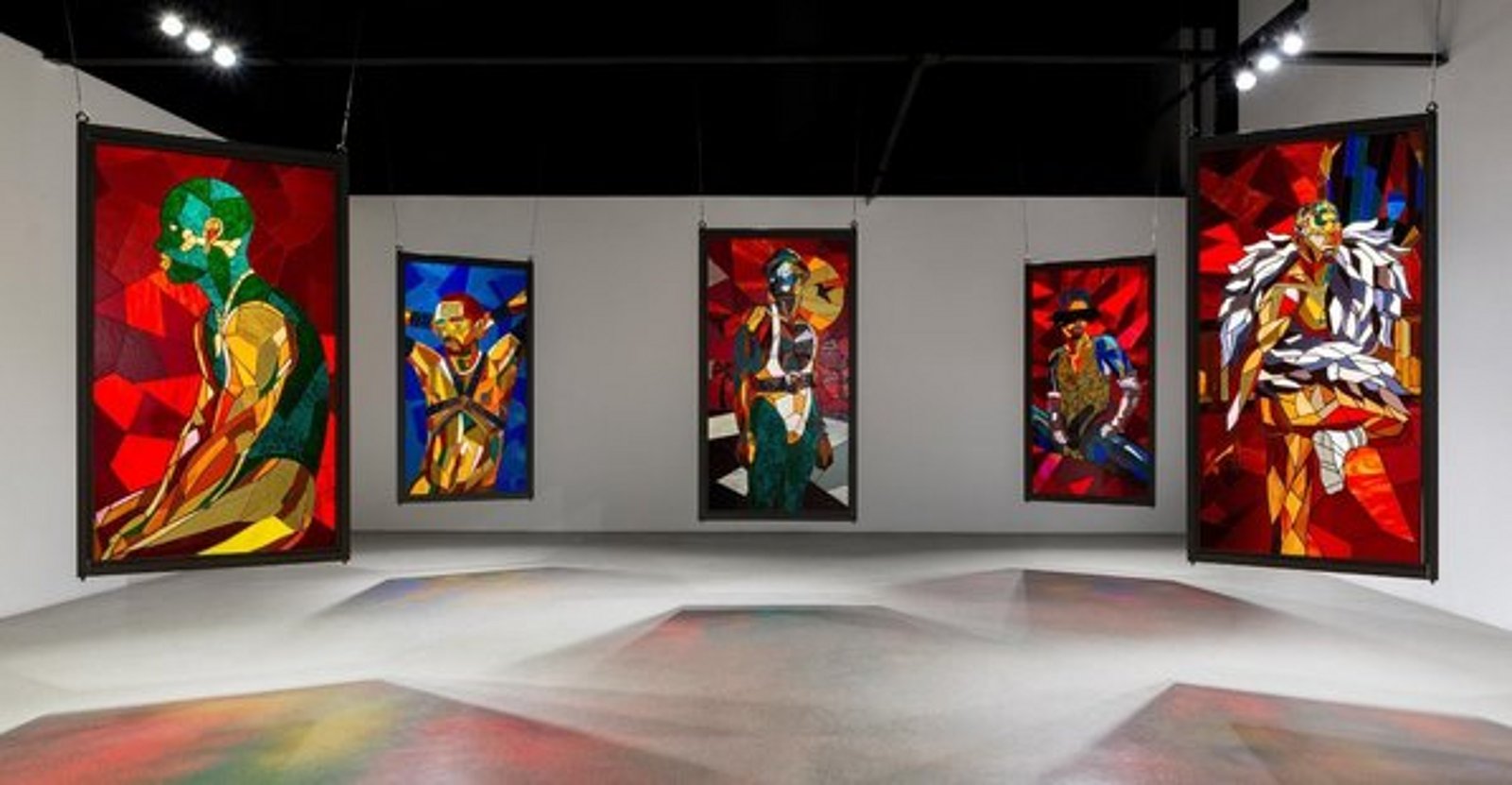
His construction of a mythical metaverse populated by his avatars allows Ruga to create a space of self-reflexivity in which political, cultural, and social systems are critiqued and parodied.
"Seine spielerische Bildsprache schöpft aus einem breiten Spektrum kultureller Referenzen, die nicht auf eine bestimmte Biologie, Herkunft oder geografische Lage beschränkt sind. Die queeren hybriden Figuren in Rugas Werk existieren in einer Grenzwelt zwischen Utopie und Realität." (ZEITZ MOCCA)
Elaborate storytelling and the allegorical value of utopia are at the heart of Ruga's practice. Traditional elements from camp, drag and travesty as well as the highest craftsmanship determine the ostensible aesthetics. Central, however, is also the reappropriation of colonial contexts and materials with Western connotations, as in his carpet paintings or glass works.
In the process, his art increasingly detaches itself from a national context and offers global points of reference, for example the cycle around the Senegalese dancer François "Féral" Benga (1906-1957), a now largely forgotten model of the Harlem Renaissance artists, who performed with Josephine Baker in Paris, or his interventions on the German-born South African Expressionist Irma Stern (1894-1966), whose works, along with works by Käthe Kollwitz (1867-1945), became a central source of inspiration early in Ruga's career.
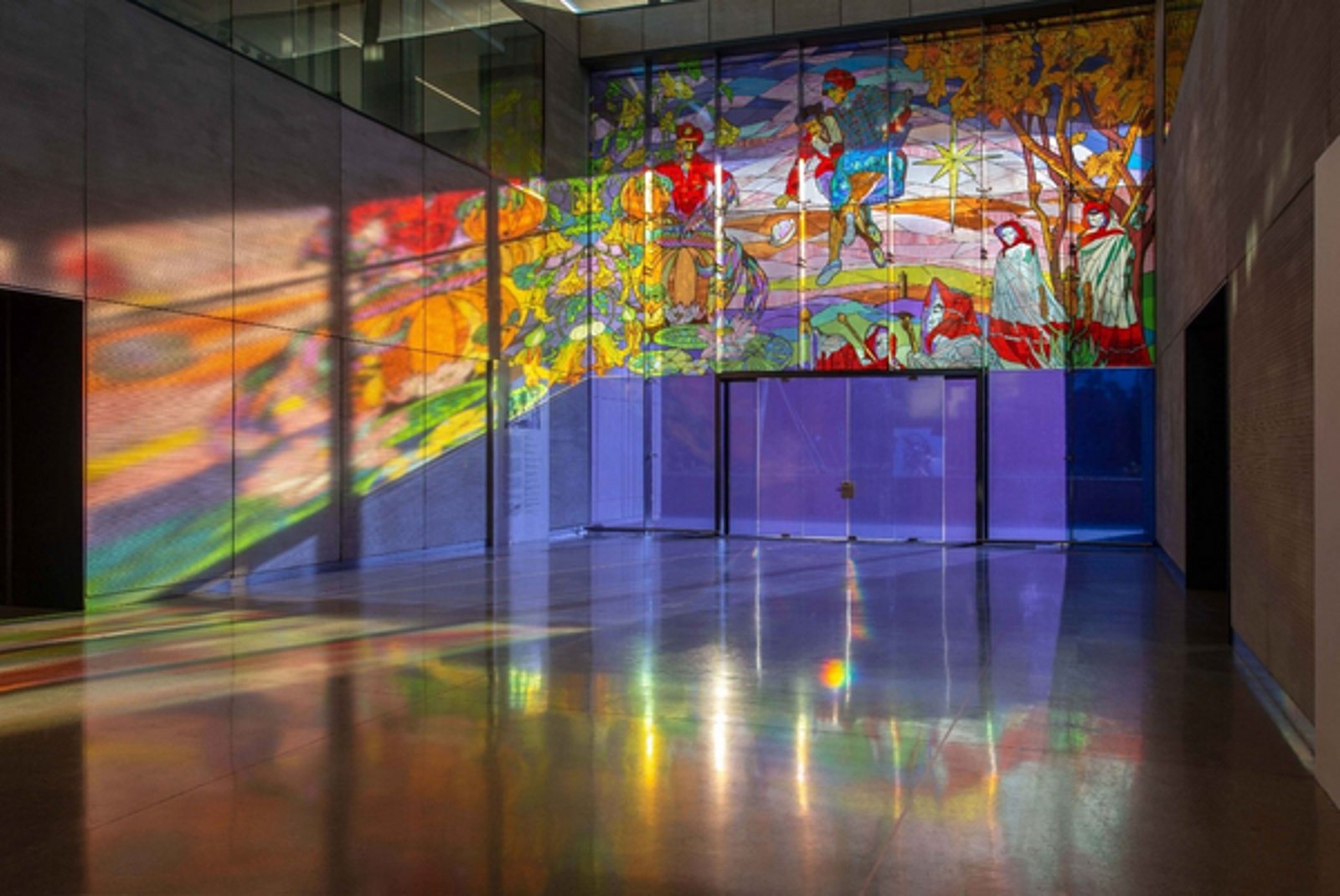
Ruga uses his utopia as a lens through which to process the troubled history of a colonial past, critique the present, and propose a possible humanist vision for the future. His positivist, even hopeful outlook, which neither overwrites nor erases the past, underscores the uniqueness of his work:
"… I don’t feel things should be destroyed or moved away. I think that you should just add on to them. There’s space for all of the conversation, and many things can live – many opposing things can live – together side by side."
In 2015, Athi-Patra Ruga received the Grand prize at the Rebcontres de Bamao, the Africa Biennale of Photography. He is co-founder of Victory of the Word, a fundraising and development project in support of the historic Lovedale print shop in Alice, Eastern Cape, and artistic director of BODYLAND, an incubator residency for artists in Amathole village, Hogback.
Exhibitions (Selection)
2021/22 Irma Stern Museum, Cape Town
2021 ARoS, Aarhus /Galerie Eva Presenhuber, New York
2020 Norval Foundation, Cape Town 2019
Haywood Gallery, London 2018
Somerset House, London / Pier 94, New York / Sean Kelly Gallery, Seattle
2017 Louis Vuitton Foundation, Paris
2016/17 Boston Centre for the Arts, Boston
2016 Bass Museum of Art, Miami / Performa 17, New York
2015 Louisiana Museum of Modern Art, Humlebæk
2013 Biennale di Venezia
Collections (Selection)
Museion Museum of Modern and Contemporary Art, Bozen
CAAC Pigozzi Collection of African Art, Genf Wedge Collection, Toronto
Smithsonian Museum of African Art, Washington, DC
Foundation Louis Vuitton, Paris
Fondation Gandur pour l’Art, Genf
Zeitz MOCCA, Cape Town
IZIKO South African National Gallery, Cape Town